LTO Alarm Check: How to Verify Plate Status & Clear an Alarm
An LTO alarm is a restriction mark placed on a vehicle or license record inside the LTO’s system, and it can block registration renewal, ownership transfer, and other official transactions until the underlying problem is resolved. It works less like a penalty and more like a hold, similar to how a bank might block part of an account until an issue is sorted out. The record itself doesn’t vanish or get deleted; it simply can’t move forward through an in-person transaction while the mark remains active.
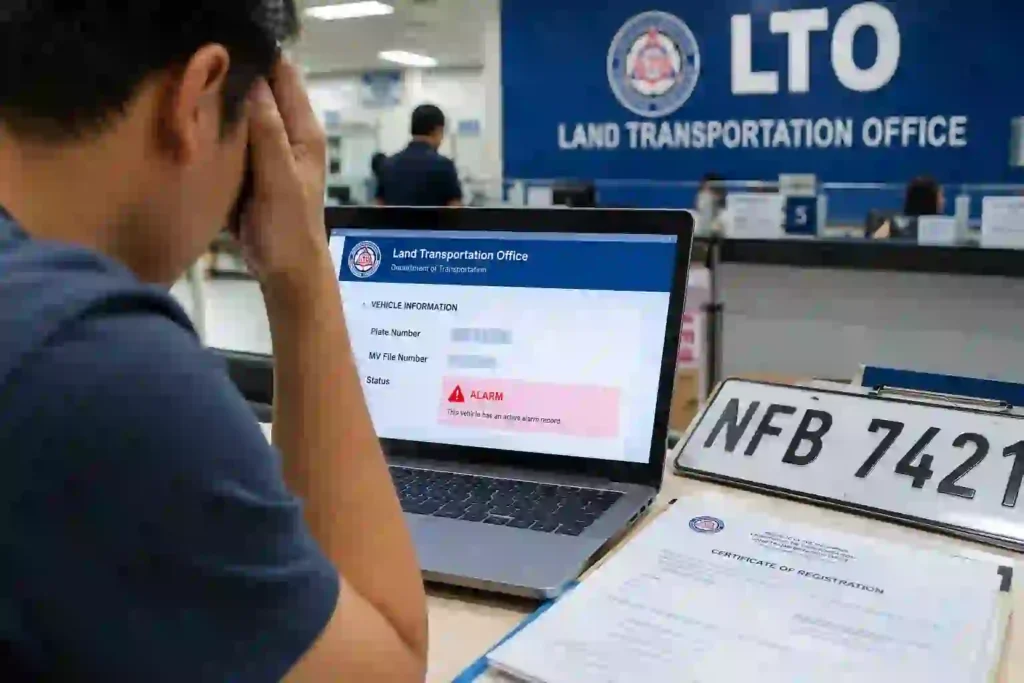
Most drivers only find out that an alarm is present the moment they’re standing at the LTO window trying to renew, watching the cashier’s system reject the transaction outright. This catches people off guard specifically because alarms don’t always come from something recent. An old due ticket, a case linked to a former vehicle owner, or a violation that only got encoded into the system months after it occurred can all sit silently until you try to transact.
Types of LTO Alarms: LTO-Side vs PNP-HPG Flags
Not every alarm comes from the same source, and knowing which type you’re dealing with changes how you go about clearing it. Broadly, alarms fall into two groups.
LTO-Side Alarms These start directly from LTO’s own records and typically include pending traffic violations, lapsed documents, or an unresolved administrative case linked to the vehicle or license. This is the more common type, and it’s usually the more straightforward one to resolve once you know what caused it.
Knowing this distinction matters most once you actually try to resolve an alarm, since an LTO-side problem and an HPG-side issue require completely different offices and paperwork to clear.
Common Causes of an LTO Alarm
A vehicle or license record can get marked for multiple different reasons, and understanding the common ones helps you narrow down what you’re likely dealing with before you even check.
- Unpaid traffic violations, including NCAP camera tickets, coding violations, and standard on-the-spot violations
- Expired or incomplete documentation, such as an expired registration or missing release test result
- Pending or unresolved legal cases linked to the vehicle or the registered owner
- PNP-HPG reports, including theft, carnapping, or suspected cloning of the vehicle’s plate or frame
- Encoding delays, where a violation committed weeks or months earlier only gets added to the system later, marking a record that seemed clean at the time
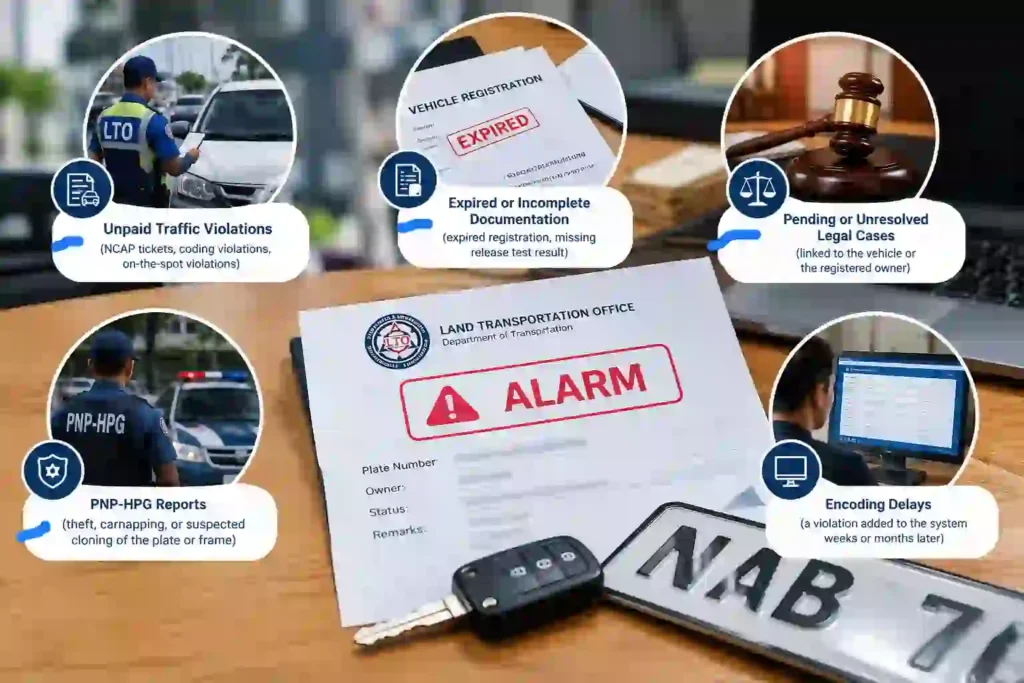
That last cause explains why a vehicle with no current violations can still show up marked. Camera-based tickets in particular sometimes take time to process before they show on your record, which is exactly why a regular check matters even when you haven’t done anything recently that you’re aware of.
Why You Should Check for an LTO Alarm Regularly
When should I check my vehicle for an LTO alarm? Check before any registration renewal, before buying or selling a used vehicle, and regularly as routine care even without an upcoming transaction. Each of these situations carries its own specific risk if you skip the check.
Before Registration Renewal Finding out about an alarm at the counter means your renewal stalls instantly, often forcing a second trip once the problem is resolved. Checking a few days forward gives you time to resolve it without missing your renewal window.
Before Buying or Selling a Used Vehicle A buyer who skips this check risks inheriting the seller’s unsettled violations or, worse, unknowingly buying a vehicle connected to a theft report. A seller with an active alarm will find that LTO simply won’t process the transfer of ownership until it’s cleared, which can stall a sale indefinitely.
As Routine Maintenance Checking every few months, even when you have no upcoming transaction, catches issues early. This matters specifically because of encoding delays, where a violation from the past can surface on your record without any new action on your part.
How to Check LTO Alarm: Official Methods
Several official channels let you check for an alarm, and each one fits a slightly different condition.
Method 1
LTMS Portal
- Go to portal.lto.gov.ph and log in using your registered email or LTO Client Number and password.
- Select the Vehicles section to view every vehicle registered under your name.
- Click on the specific vehicle to open its detailed record.
- Look for marks such as “With Alarm,” “Pending Case,” or “For Verification” listed in the vehicle details.
Method 2
SMS Text Service
- Open your phone’s messaging app.
- Type LTO VEHICLE followed immediately by your plate number, with no space in between.
- Send the message to O2600.
- Wait for a reply verifying your vehicle’s status; this typically costs around ₱2.50 per message based on your carrier’s standard SMS rate.
Method 3
In-Person at an LTO District Office
Visit the branch where your vehicle was originally registered, bringing your OR, CR, and a valid ID. This route works well when an online or SMS check returns unclear or opposing results, since staff can pull a more detailed record directly.
Method 4
PNP-HPG Office
If you specifically doubt a stolen vehicle or carnapping-related mark, visiting your nearest PNP-HPG office and requesting a check with your CR and OR gives you a more direct answer, since this type of alarm comes from their system rather than LTO’s.
Understanding Your Alarm Check Result
Once you get a result, knowing what each label usually means helps you decide your next move.
| Status Label | What It Generally Indicates |
| With Alarm | An active mark currently blocking transactions on this record |
| Awaiting Case | An unresolved legal or administrative matter linked to the vehicle or owner |
| For Verification | The record needs manual verification before a transaction can proceed |
| No Alarm Found | No active mark exists on the record based on the current check |
A “No Alarm Found” result is comforting but not always the final word, especially if you suspect a recent violation hasn’t been encoded yet. If something feels off despite a clean result, following up at your LTO branch closes that gap with more certainty than depending on the online or SMS check alone.
How to Resolve an LTO Alarm
How do I clear an LTO alarm once I find one? The resolution path depends completely on whether the alarm started from LTO’s own records or from a PNP-HPG report, since each follows a different process. Identifying which type you’re dealing with is the first real step toward fixing it.
Resolving an LTO-Side Alarm
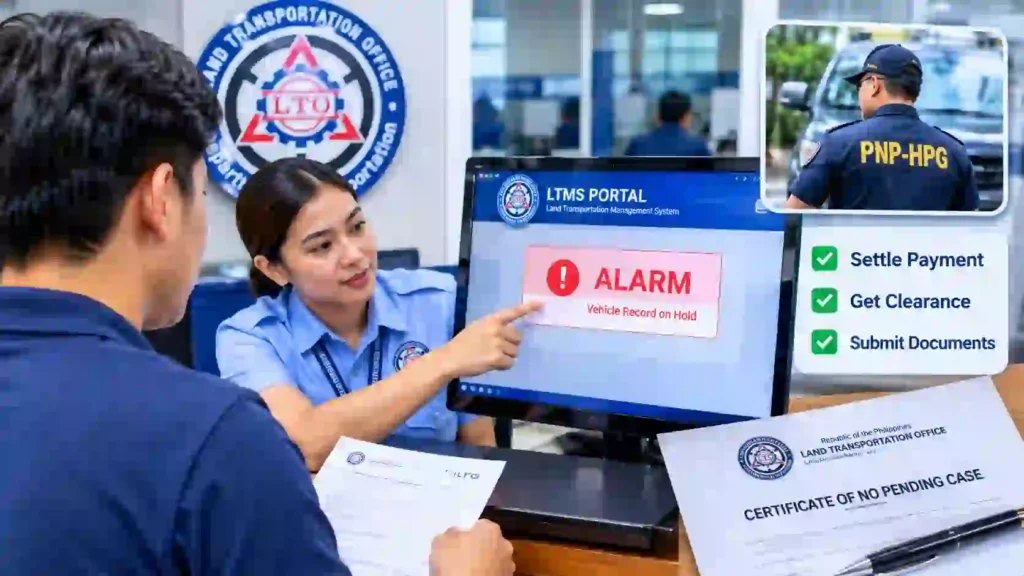
- Visit your LTO branch or check through LTMS to confirm exactly what caused the mark, whether it’s an unpaid fine, expired document, or pending case.
- Settle the required payment at the LTO cashier, or submit whatever missing document caused the mark.
- Once payment is posted or the document is accepted, the system usually lifts the alarm on its own.
- Request a Clearance or Certificate of No Pending Case for your own records, which is useful as proof if any conflict comes up later.
Resolving a PNP-HPG Alarm
- Obtain a Macro-Etching Certificate from the PNP-HPG Crime Lab, which verifies that the vehicle’s engine and chassis numbers haven’t been tampered with.
- Secure a Lifting of Alarm Order from the specific HPG office or unit that started the mark, typically requiring proof of ownership and evidence that the underlying problem has been resolved.
- Submit both the HPG Clearance and the Lifting Order to LTO’s Operations Division so the system record can be updated.
Contesting an Alarm Issued in Error
If you think a violation was recorded against the wrong plate number or involves a case of mistaken identity, you usually have the right to file a formal dispute rather than simply paying a fine you don’t think applies to you. Bringing supporting documentation, such as proof that the vehicle was elsewhere or evidence of a data entry error, can greatly strengthen this type of dispute.
Can You Renew Registration With an Active Alarm?
Can I still renew my vehicle registration if there’s an alarm on it? No, an active alarm blocks registration renewal completely until the underlying issue is resolved, regardless of how minor the original violation might seem. LTO’s system is built specifically to prevent this kind of transaction from going through while a mark remains open.
This is exactly why checking ahead of your renewal date matters so much. Discovering an alarm on renewal day itself often means walking away without a completed transaction, then returning once the issue is actually settled, which can mean paying a late-registration penalty on top of whatever caused the alarm in the first place.
What Happens If You Ignore an LTO Alarm?
Treating an alarm as something to deal with eventually rarely works out well. Beyond the instant block on renewal and transfer transactions, driving a vehicle with an unresolved alarm carries its own risk during a routine checkpoint, since officials can flag the same issue on the spot.
If the underlying cause involves an unregistered or improperly documented vehicle, this can lead to impoundment or towing, along with additional penalties layered on top of the original issue. An alarm connected to a serious matter like a pending legal case or an HPG flag only grows more complicated to resolve the longer it sits unaddressed, since supporting documents and witnesses become harder to track down over time.
Why Your Alarm Check Might Show No Result
Sometimes, a check comes back empty or uncertain even when you have reason to believe something might be flagged. A few details account for most of these cases.
- Recent violations that haven’t been encoded yet, since there’s often a delay between an event and its entry into the system
- A typo in the plate number or MV File Number, which returns a blank result rather than an error message
- System maintenance or temporary downtime, particularly during peak renewal periods when host load increases
- A flag that exists specifically in PNP-HPG’s system rather than LTO’s, which won’t show up through an LTMS or SMS check at all
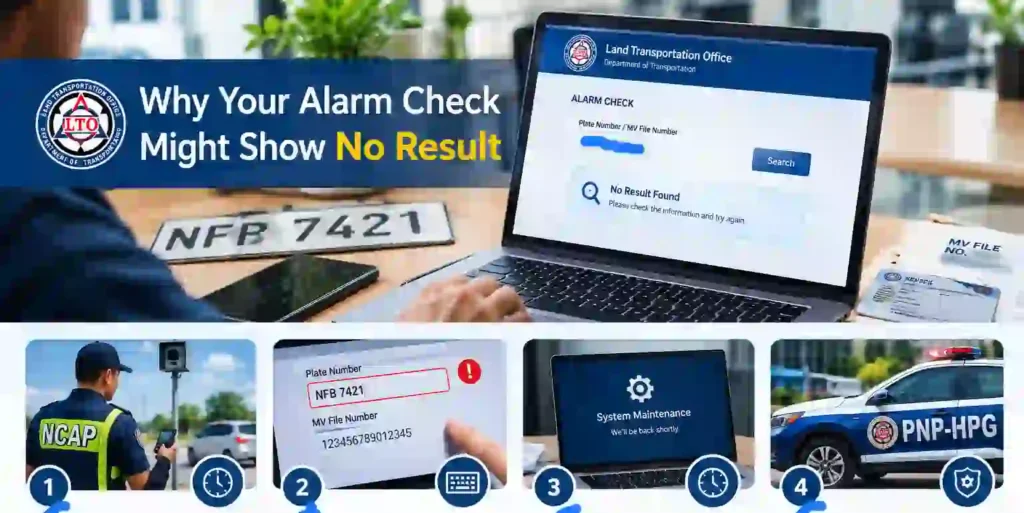
If your result seems inconsistent with what you’d expect, following up directly at an LTO branch or, if theft or cloning is a concern, a PNP-HPG office resolves the confusion more reliably than repeating the same online check.
Are There Legitimate Third-Party Services for This?
Can a fixer or third-party website clear my LTO alarm for a fee? No legitimate service outside of LTO or PNP-HPG can actually clear an alarm, since only these agencies have the authority to update the official record. Any site or individual offering to “fix” or “remove” your alarm for a fee should be treated with serious doubt.
Some third-party websites do offer plate or alarm lookup tools, and while a few may pull from publicly available information, none of them replace an actual check through LTO’s own official channels. If a checking service asks for a fee precisely to reveal whether your vehicle has an alarm, that’s a signal to go directly to the official LTMS Portal or SMS service instead, both of which are either free or charge only the standard text messaging rate.
Tips to Avoid Getting an LTO Alarm
A handful of habits go a long way toward keeping your record clean. Settle traffic violations as soon as they happen rather than assuming they’ll be forgotten, since encoding delays mean an unpaid ticket can resurface months later at the worst possible time. Keep your registration, emission testing, and insurance documents updated well before their expiry dates, since even an expired document can trigger a flag on its own.
If you’re buying a secondhand vehicle, run both an LTMS check and a PNP-HPG inquiry before completing the purchase, since a clean-looking OR/CR doesn’t guarantee a clean system record. Checking your own vehicle every few months, even without an upcoming transfer, keeps small issues from quietly building into a bigger problem by the time you actually need to renew.
Frequently Asked Questions
Conclusion
An LTO alarm rarely reveals itself until you’re already at the counter trying to complete a transaction, which is exactly why checking ahead of time matters more than it might seem. Knowing whether you’re dealing with an LTO-side issue or a PNP-HPG mark determines your entire path forward, since the two need completely different offices and paperwork to settle.