Child Restraint System LTO: RA 11229 Requirements, Exemptions, and Penalties
What Is the Child Safety in Motor Vehicles Act (RA 11229)?
Republic Act No. 11229, known as the Child Safety in Motor Vehicles Act, requires children traveling in private vehicles to be properly secured in an approved child safety system. President Rodrigo Duterte signed the law on February 22, 2019, following years of data showing thousands of child deaths and injuries from road crashes in which children were unsecured or improperly seated on an adult’s lap.
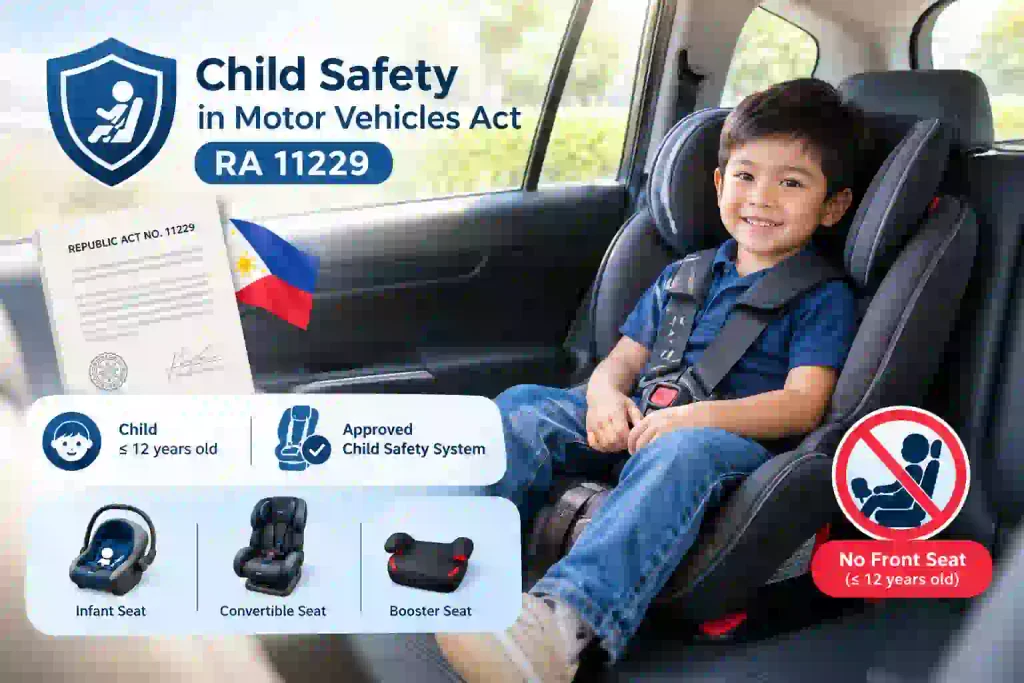
The law defines a child as anyone 12 years old or younger, and it specifically prevents a child of that age from sitting in the front seat unless the applicable height requirement is met. A child safety system, under the law’s own definition, is any device made to hold a child in a sitting or reclined position and limit body motion during a crash or sudden stop. This covers infant car seats, convertible seats, and booster seats, provided they meet the safety standards required by law.
This isn’t a rule that is present just to give traffic enforcers something to check. Global road safety data cited in support of the law shows that correctly used safety systems greatly reduce the risk of death for young children, which is exactly the kind of outcome RA 11229 was designed to protect.
Who Needs to Use a Child Restraint System?
Does my child need a car seat, or can they just use the regular seatbelt? A child who is 12 years old or below must use a proper child safety system, unless the child is at least 150 centimeters, or roughly 4 feet 11 inches, tall and correctly secured with the regular seatbelt. Age alone doesn’t settle the question here; height is the deciding factor once a child gets close to that limit.
This creates a common situation for Filipino parents: a tall 9-year-old who’s already past 150 cm may legally use a regular seatbelt, while a shorter 12-year-old still needs a booster seat. Assessing this by age alone, without checking actual height, is one of the simplest ways parents can unintentionally become non-compliant.
The law also makes clear that a child covered by this height and age rule cannot ride in the front seat unless they’ve already reached at least 150 cm in height. Even with a booster seat installed, this specific seating limitation still applies.
Types of Child Restraint Systems and How They’re Used
Not every child safety system works the same way, and choosing the right type commonly comes down to a child’s age, weight, and height rather than age alone. Car-seat manufacturers and road-safety organizations commonly group these into three broad categories.
Rear-Facing Seats Designed for babies and younger children, these seats face the rear of the vehicle to better support a small child’s head and neck during a sudden stop. Most safety guidance suggests keeping a child rear-facing for as long as the seat’s own weight and height limits allow, rather than changing early just because a birthday passed.
Forward-Facing Seats Once a child outgrows the rear-facing seat’s limits, a forward-facing seat with an inner harness becomes the next stage. These seats still fully secure the child’s body, unlike a booster, which relies on the vehicle’s own seatbelt.
Booster Seats Booster seats raise a child up so the vehicle’s regular seatbelt fits correctly across the chest and hips instead of the neck or stomach. This stage usually continues until the child reaches the law’s 150 cm limit, at which point a regular seatbelt alone becomes enough.
Checking the specific weight and height limits printed on your specific seat model matters more than following generic age brackets, since products vary between models.
Which Vehicles Does the Law Actually Cover?
RA 11229 was written specifically for private motor vehicles, including sedans, SUVs, pickups, and vans used for personal transport. Public utility vehicles like jeepneys, buses, and taxis fall under a separate clause of the same law, which directs the Department of Transportation to study appropriate child safety measures for those vehicle types rather than immediately requiring the same safety requirements.
This difference matters in daily life more than it may seem. RA 11229 does not currently apply the same child safety requirement to public utility vehicles as it does to covered private vehicles; the law directs the DOTr to study appropriate child-safety measures for public transport instead. Using whatever safety measures are practically possible, even in a public vehicle, remains a good safety practice regardless of what the law currently requires.
When Is a Child Restraint System Not Required?
Are there any situations where I don’t need a car seat for my child? The law identifies situations where the standard child safety requirement does not apply or may be altered, including medical emergencies, certain certified medical or developmental conditions, and the 150 cm height exclusion. The implementing rules also identify other similar situations under the relevant provisions. Outside of these conditions, the safety requirement applies in full.
Medical Emergencies If a child needs urgent medical attention and using a safety system would delay getting them to care, this requirement may be waived for that specific trip. This covers situations such as rushing an injured or sick child to a hospital, where immediate medical attention takes priority over the standard safety procedure.
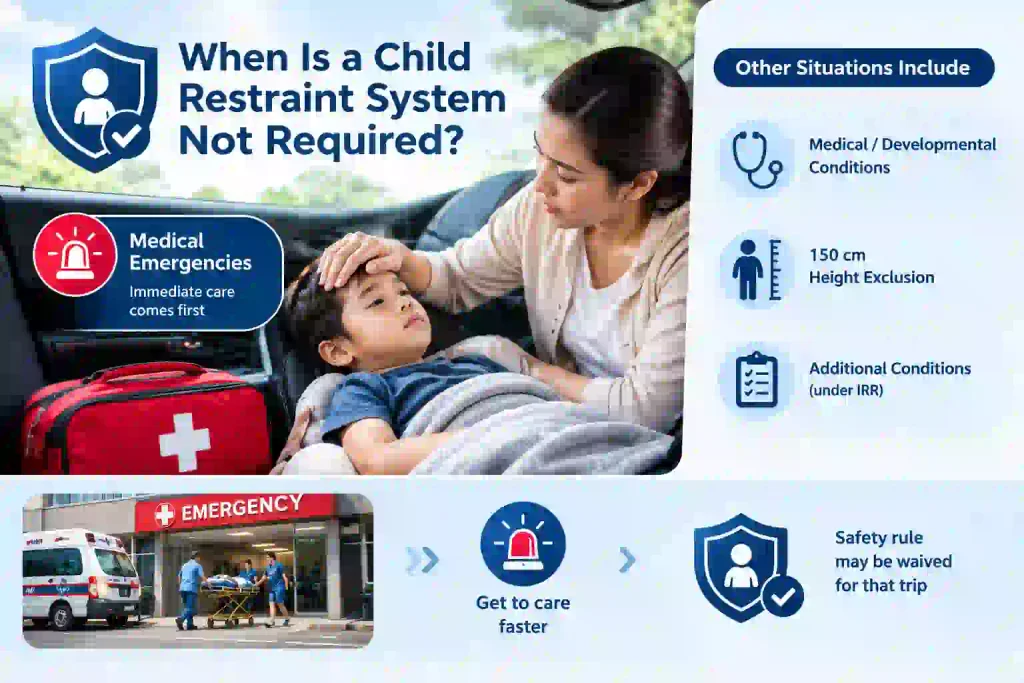
Certified Medical or Developmental Conditions A child may be excused from the standard safety requirement if a licensed physician certifies that a medical, psychological, or developmental condition makes standard safety use risky to the child’s health. Even with this exemption, the implementing rules note that an altered or specially designed safety system should still be used whenever one is required for the child.
Height Threshold Once a child reaches 150 centimeters in height, regardless of their age, they can legally use the vehicle’s standard seatbelt instead of a child safety system.
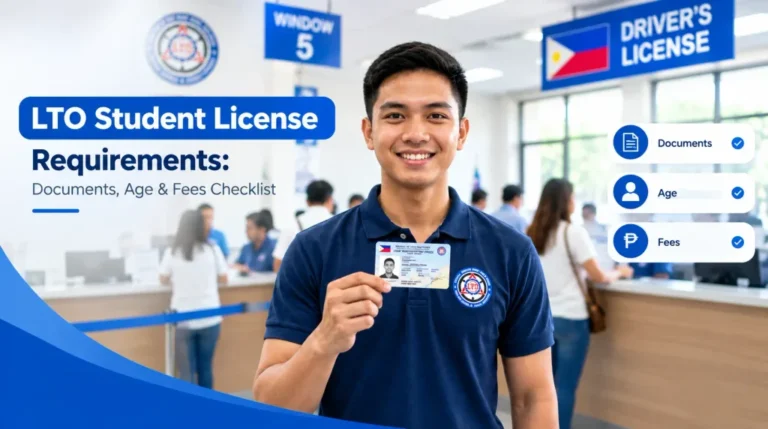
Before driving in the Philippines, review the LTO Student Permit Requirements to understand the eligibility rules and documents needed for first-time drivers.
Penalties: What a Violation Really Costs You
How much is the fine for not using a child restraint system? Under the law’s implementing rules, drivers face a fine of ₱1,000 for a first violation, ₱2,000 for a second violation, and ₱5,000 plus a one-year driver’s license revocation for a third and any later violation. This escalating structure specifically targets repeat non-compliance rather than treating every violation the same way.
That license suspension attached to a third offense is a detail many parents overlook until it directly affects them. Unlike a fine you simply pay and move on from, a suspended license can disrupt daily routines such as school runs, work commutes, and general mobility for the entire family, not just the driver.
Separately, the law also fines manufacturers, dealers, and sellers who violate product safety requirements for child safety systems, with fines reaching into the tens of thousands of pesos per product. This part of the law helps keep inferior or falsely certified safety seats out of the market in the first place, protecting families before a violation ever happens on the road.
How LTO and Traffic Enforcers Check Compliance
Traffic enforcers, whether from LTO, the PNP-Highway Patrol Group, or local traffic units like MMDA, can flag a vehicle for non-compliance during a routine stop or checkpoint if a child is found riding without proper safety measures. This typically means visually confirming whether a child under 12 is secured in an appropriate seat, or whether a taller child has legally switched to a regular seatbelt based on height rather than assumption.
How to Install a Child Restraint System the Right Way
A car seat only works as intended when it’s installed correctly, and even a well-made seat provides less effective protection if it shifts or sits at the wrong angle during a crash. Following your specific seat’s manufacturer’s manual should always take priority over generic advice, since installation details vary by model and vehicle type.
That said, a few general principles apply across most seats. The seat should sit snugly against the vehicle seat with minimal side-to-side movement once properly installed, whether through the vehicle’s seatbelt or an ISOFIX/LATCH anchor system if your vehicle supports it. For rear-facing and forward-facing seats with an internal harness, the straps should sit flat without twists and fit firmly against the child’s body, allowing only a small amount of slack.
Booster seats depend entirely on the vehicle’s own seatbelt fitting correctly across the child’s chest and hips rather than across the neck or stomach. If the seatbelt consistently sits too high on the neck even with the booster in place, that particular seat and vehicle combination may not be the right match, and checking other seating positions or a different booster model is worth doing.
Mistakes That Quietly Put Kids at Risk
Some of the most common control mistakes come from good aims rather than carelessness, which makes them easy to overlook until something goes wrong.
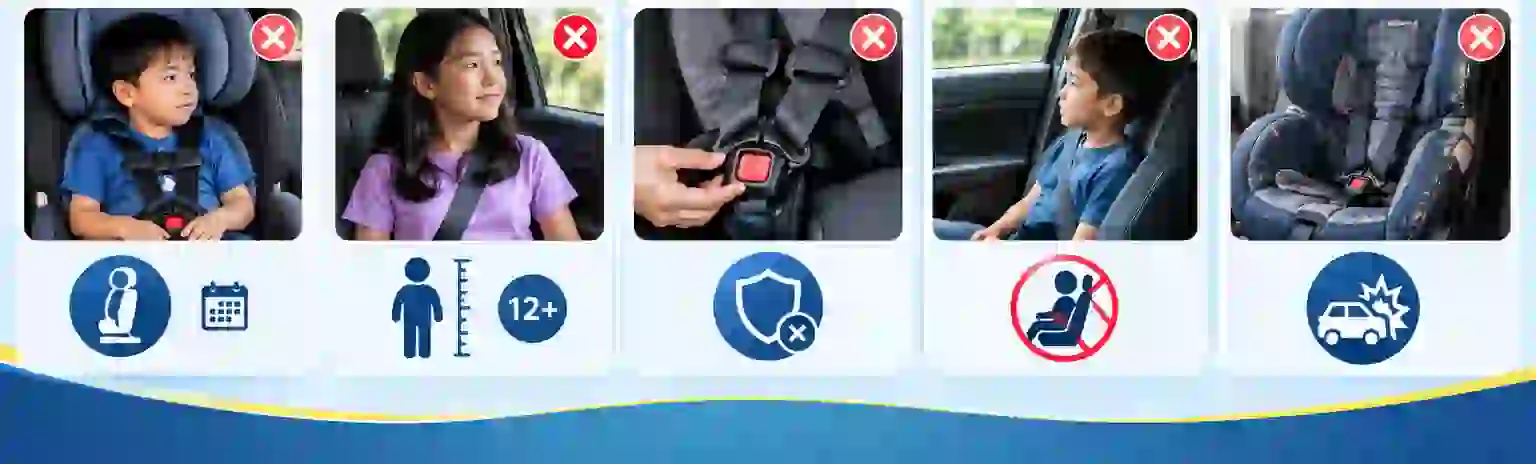
- Switching to a forward-facing seat too early, based on a birthday rather than the seat’s actual height and weight caps
- Judging seatbelt readiness by age instead of height, missing the fact that a shorter 12-year-old may still lawfully need a booster
- Loose harness straps or a loosely secured seat base, which greatly reduces protection even with the correct seat type installed.
- Allowing a child to sit in the front seat “just this once,” even though the law’s seating regulations don’t include exceptions for short trips.
- Using a hand-me-down seat with an unknown crash history, since a seat involved in even a minor prior crash may no longer secure properly.
Ride-Sharing, Rentals, and Borrowed Vehicles
Traveling by ride-hailing service, a rented car, or someone else’s vehicle doesn’t remove the underlying safety need, even in conditions where the specific legal scope is less clear-cut than a private family vehicle. If you regularly travel with young children using a service like Grab, checking whether the driver’s vehicle has a compatible restraint option in advance, or bringing a portable one yourself, avoids being caught without a real solution during the trip.
For rental vehicles, most rental companies in the Philippines can provide a child seat if required at the time of booking, though availability and specific models vary by provider. Verifying this ahead of your trip, rather than assuming one will be available on pickup day, saves you from having to purchase a seat at the last minute in an unknown city.
Using an Expired or Substandard Child Restraint System
Can I keep using my old child restraint system if it still looks fine? A car seat that’s expired, been in a prior collision, or doesn’t carry the required safety certification should not be used, even if it appears structurally intact. Plastic parts and internal padding degrade over time in ways that aren’t always visible from the outside, and a seat’s actual protective performance can quietly decline well before it looks worn.
Checking your specific seat’s manufacture date and any stated expiry period, usually printed on a label somewhere on the seat frame, is worth doing periodically rather than assuming an older seat is automatically safe. The law’s applicable rules also specifically address counterfeit or substandard products carrying fake safety certification marks, which is exactly the kind of seat that looks legitimate on the surface while offering little real protection.
Frequently Asked Questions
Conclusion
RA 11229 exists because too many children in the Philippines were being seriously hurt or killed in crashes that a properly used restraint system could have prevented. Knowing the actual height threshold, the specific grounds for exclusion, and the real cost of rule breaches turns this from an abstract rule into something you can actually plan around on every trip.
The fine structure alone isn’t really the point here; a ₱1,000 first-offense penalty is far less important than what happens to an unrestrained child during an actual crash. Treating the height rule, correct seat type, and proper installation as non-negotiable, rather than something to figure out only after getting stopped at a checkpoint, is what actually keeps kids safer on Philippine roads.