Certificate of Registration LTO: Guide for Vehicle Owners
Registration, or CR, is the official document the LTO provides to verify that a specific motor vehicle is legally registered under a specific owner’s name. It functions as your vehicle’s lasting identity record, containing details like the engine number, frame number, and classification, and it stays linked to that vehicle for as long as it remains registered under your name. Every vehicle legally operating on Philippine roads, whether a brand-new sedan, a secondhand motorcycle, or a company-owned delivery van, needs a valid CR.
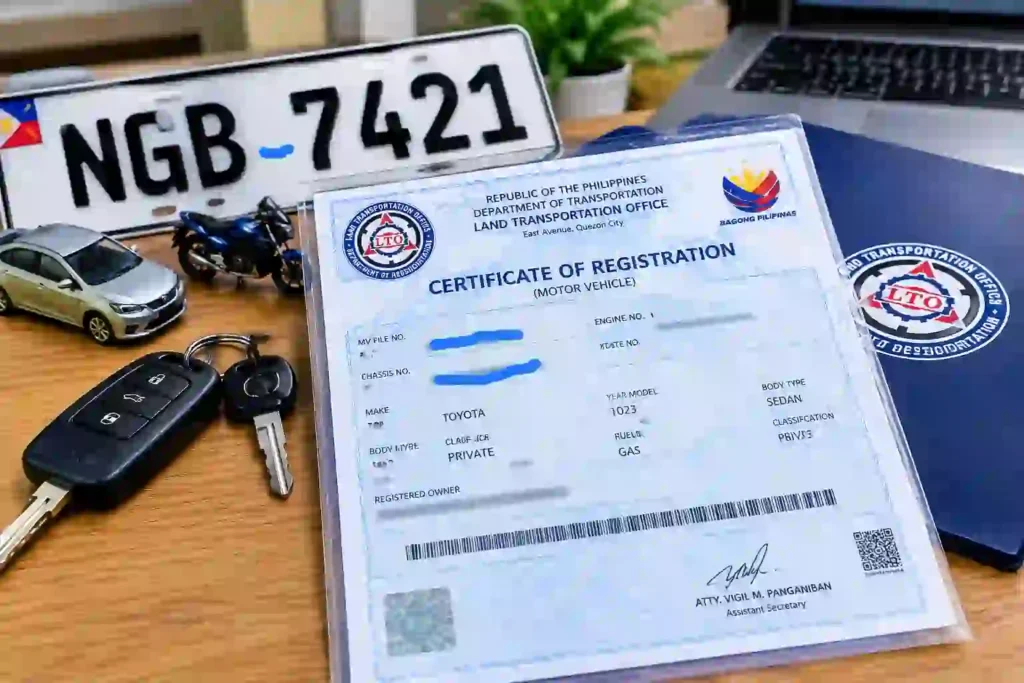
Unlike registration renewal, which occurs yearly, the CR itself isn’t something you renew every year. It only changes when something about the vehicle or its ownership actually changes, such as a sale, a name correction, or a modification to the vehicle itself. This is exactly why losing or damaging a CR feels more disturbing than losing a common receipt; it’s linked to the vehicle’s complete legal identity, not just a single transaction.
CR vs OR: What’s the Difference and Why You Need Both
What’s the difference between the CR and the OR? The CR proves who legally owns and is responsible for the vehicle, while the OR is the receipt released each year proving that registration fees for that specific period have been paid. Confusing the two, or supposing one can replace the other, is one of the most common mix-ups among Filipino vehicle owners.
Both documents need to be kept in the vehicle at all times, since traffic enforcers can ask for either one during a stop, and neither one legally replaces the other. Photocopies generally aren’t accepted as a substitute for either original document, which is worth remembering if you’re inclined to leave the originals at home for protection.
What Information Appears on Your CR
Your CR contains multiple categories of information, and knowing what should be on it helps you catch an error early rather than discovering it during a more urgent transaction.
Owner information, including full name and registered address
Vehicle details, such as make, series, body type, color, and year model
Technical identifiers, including engine number, frame number, and vehicle identification number (VIN)
Classification details, like fuel type and total vehicle weight where valid
Official markings, including the LTO seal and an authorized signature verifying the document’s validity
The physical document itself is printed on security paper with distinct patterns designed to make it difficult to fake, and it’s clearly longer than a standard letter-size sheet. If your CR ever looks clearly different from what you’d expect, particularly around these security features, that’s worth marking directly with LTO rather than supposing it’s just an older printing format.
CR vs CRE: Fully Paid vs Financed Vehicles
What is a CRE, and how is it different from a CR? A CRE, or Certificate of Registration – Encumbered, is issued instead of a standard CR when the vehicle is still under an active auto loan or financing agreement. This distinction exists specifically to mark vehicles that aren’t yet fully owned free and clear by the person named on the document.
Once you finish paying off the loan, the encumbrance doesn’t automatically disappear from your registration record. You’ll need to secure a Cancellation of Personal Property from your financing bank, then request a CRE-to-CR conversion at LTO to show that the vehicle is now fully yours. Skipping this step can complicate a future sale, since a buyer’s own transfer of ownership process typically requires presenting a clean CR rather than one still marked as encumbered.
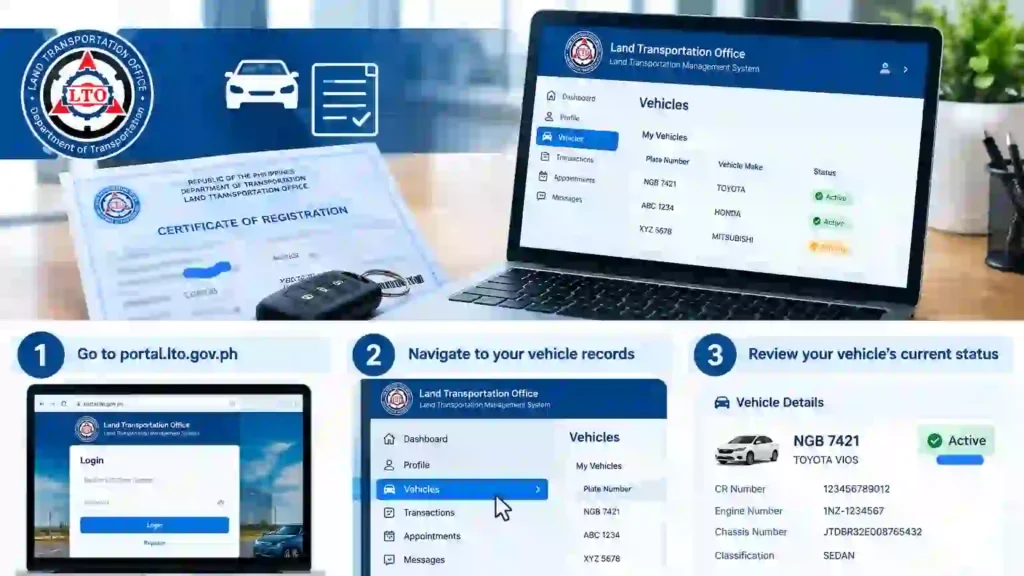
How to Check Your CR Status Online
Checking your CR status matters most when you’re waiting for a brand-new registration to process or verifying that a duplicate request is moving forward as expected.
Step 1
Go to portal.lto.gov.ph
Log in using your registered email or LTO Client Number and password.
Step 2
Navigate to your vehicle records
Select the Vehicles section to view every vehicle presently registered under your account.
Step 3
Review your vehicle’s current status
Details here typically show whether your registration and CR are active, awaiting, or marked for any reason.
If your online status looks unclear or doesn’t match what you expect, visiting your registering LTO branch directly, or calling beforehand if the branch offers phone support, gives you a more definitive answer than repeatedly checking the portal.
The Temporary CR in 2026: What Vehicle Owners Should Know
Is a Temporary CR issued in 2026 legally valid? Yes, LTO allows temporary Certificates of Registration to be issued on A4 bond paper when security paper is unavailable, and the temporary document remains valid for all legal purposes until the standard CR is replaced and printed on security paper. This is worth knowing particularly if you registered or renewed recently and received a document that looks different from the CR you might remember from previous years.
What to Do If Your CR Is Lost, Stolen, or Damaged
What’s the first thing I should do if I lose my CR? Prepare a notarized Affidavit of Loss describing the circumstances, since this document is required before LTO will process any replacement. If the CR was stolen rather than simply misplaced, filing a police report adds another layer of documentation that some branches particularly request.
A damaged CR follows a similar but distinct path, usually needing a Notarized Affidavit of Mutilation instead of an Affidavit of Loss, since the document still physically exists but is no longer in acceptable condition. In both situations, you cannot simply request a photocopy of your old CR as a substitute; LTO needs you to formally apply for a proper replacement through its duplicate CR process.
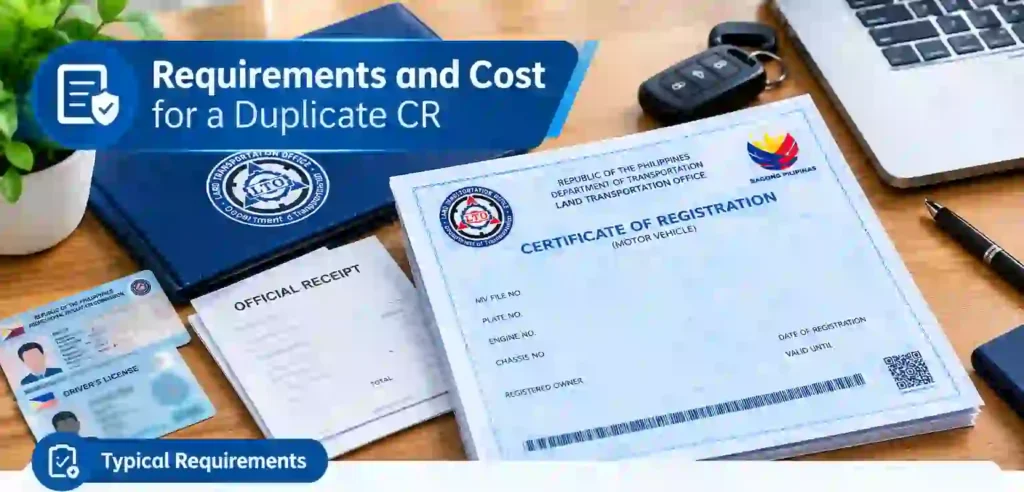
Requirements and Cost for a Duplicate CR
Collecting complete documentation before your branch visit prevents the irritation of being sent home for a missing paper.
Typical Requirements
Cost Considerations
Reported fees for a duplicate CR vary depending on the source and specific transaction involved, with some sources citing a modest per-document fee under LTO’s standard fee schedule and others noting additional processing charges on top of that base amount. Since fee schedules are periodically updated, verifying the exact current amount directly with your LTO branch or through the LTMS Portal before your visit is the most accurate way to avoid a surprise at the cashier.
Step-by-Step: Applying for a Duplicate CR
Most branches follow a similar sequence for processing a duplicate CR appeal.
Prepare your Notarized Affidavit
Have your Affidavit of Loss or Mutilation signed by the registered owner and properly notarized before heading to the branch.
Visit the LTO district office where your vehicle was originally registered
This is typically the branch keeping your complete registration history, which can speed up certification compared to a branch with no prior record of your vehicle.
Submit your complete document set
Present your affidavit, latest OR, valid IDs, and any additional documents your specific branch requires.
Complete a vehicle inspection if required
Some branches ask for a fresh check or stencil form as part of verifying the vehicle’s details before issuing a new CR.
Pay the applicable fee and receive your duplicate CR
Processing commonly takes a few working days at most branches, though busier districts in Metro Manila can sometimes take longer during peak periods.
How to Correct Errors on Your CR
A CR with an incorrect name, engine number, or address can cause real issues down the line, particularly during a future sale or insurance claim. LTO addresses this through an appeal for Correction of Entry rather than a full duplicate CR application in most cases.
Correction of Name Bring your original CR, OR, valid ID, and a supporting document such as your PSA Birth Certificate verifying the correct spelling or details.
Engine Replacement or Chassis Number Correction Present documentation proving the change, such as a sales invoice or mechanic’s certification for the engine, since technical identifiers need stronger supporting evidence than a simple name correction.
Change of Address Submit proof of your new address along with your original CR and valid ID, since this update affects where future renewal notices and messages get sent.
Vehicle Color Change If you’ve had your vehicle recolored, updating this on your CR keeps the document consistent with the vehicle’s actual current appearance, which matters if an inspector visually compares your vehicle to what’s on record.
Straightforward clerical corrections are often processed at the originating branch without extensive delay, though more involved changes, such as those affecting technical identifiers, may need additional verification before LTO approves the update. Changes involving a full transfer of control to a new person follow a separate, more involved process rather than a simple correction of entry.
Driving Without a Valid CR: What Happens
Operating a vehicle without carrying your valid CR, or with a CR that no longer shows your vehicle’s actual registration status, exposes you to fines and potential problems at a checkpoint. Since the CR and OR both serve as proof of legal registration, traffic enforcers can treat a missing or clearly outdated CR the same way they’d treat an unregistered vehicle.
Beyond the immediate fine, an invalid or missing CR can also stall other transactions you might need urgently, such as filing an insurance claim after an accident or completing a sale. Keeping your CR current and reachable avoids compounding a simple documentation issue into a bigger problem during an already difficult situation.
How to Verify Your CR Is Authentic.
Verifying a CR’s authenticity matters most when buying a secondhand vehicle, since a fake or changed document can hide a much bigger problem with the vehicle’s actual legal status. Cross-checking the plate number, engine number, and chassis number printed on the CR against the physical vehicle itself is a sensible first step, since mismatches here are a clear red flag.
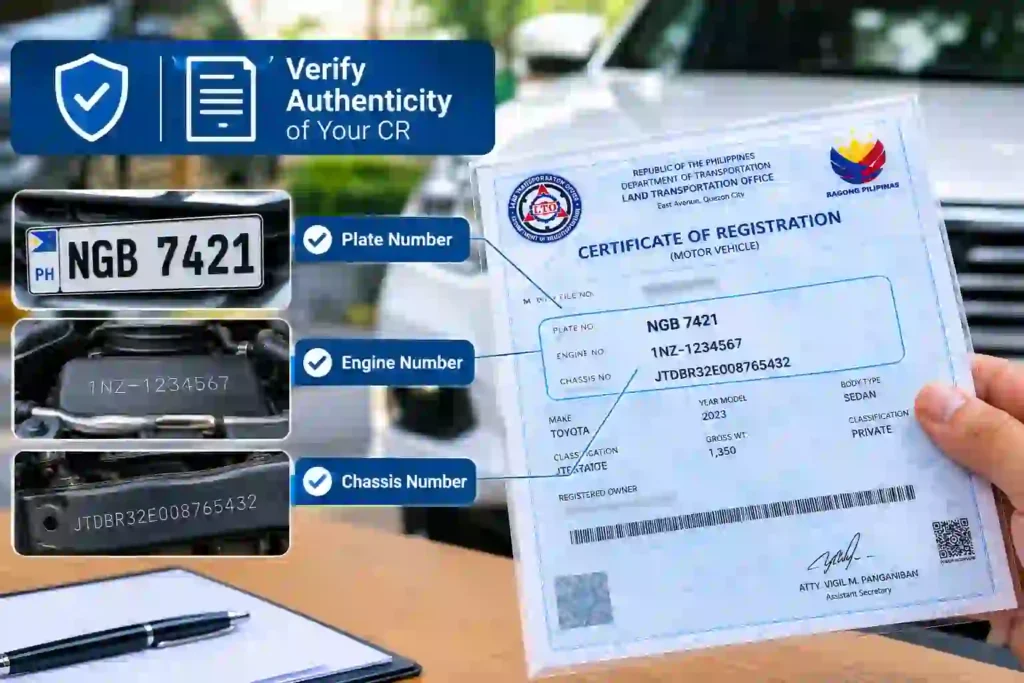
Verifying the CR’s details directly with LTO, either through the LTMS Portal or by visiting the registering branch with the seller present, adds another layer of confidence before completing any purchase. Given how much a vehicle transaction depends on the CR being genuine, treating this verification step as optional isn’t worth the risk it introduces.
Tips to Protect Your CR
A few simple habits go a long way toward avoiding the hassle of a duplicate CR application. Keep your original CR at home in a safe, dry location, and consider laminating a working copy for daily use in the vehicle while protecting the uncoated original as a backup.
Take a clear photo or scan of your CR and store it somewhere easily accessible on your phone, since having a digital copy speeds up reporting a loss or verifying details over the phone if needed. Avoid leaving your CR inside the vehicle when it’s parked for extended periods, since a stolen vehicle often means a stolen CR as well, adding an extra document to replace on top of the vehicle itself.
Frequently Asked Questions
Conclusion
Your Certificate of Registration carries more weight than most drivers realize until the moment it’s missing, damaged, or shows an error that blocks an urgent transaction. Understanding the difference between your CR and OR, knowing what a CRE means if your vehicle is still financed, and keeping your document details accurate all help you avoid confusion later.